Imagine meeting someone who could be an ideal customer for your business.
You ask what they are looking for. They describe a problem your team solves every day.
You know you can help. You have the experience, the people, and the process to do excellent work.
Then they ask what your company does.
You begin explaining your capabilities. You mention your integrated approach, your customized solutions, and your commitment to excellence. You describe your services in the same language your team uses internally.
The person listens politely.
But you can tell the connection is not quite happening.
Nothing you said was necessarily wrong. You simply answered a different question from the one they were asking.
They wanted to understand how you could help them.
You told them what your business does.
That gap between what a company knows about itself and what customers understand about it is one of the most important challenges in business communication.
And it is the starting point for Bridging the Gap.
Knowing Your Business Is Not the Same as Explaining It
In the first three articles of our First Impressions series, we explored how customers begin forming opinions, how those impressions become a brand, and why an attractive website must also be useful.
In First Impressions: A Beautiful Website Isn’t Enough, we looked at how visitors need clear information, intuitive navigation, and a reason to take the next step.
But even a beautifully organized website cannot solve a message that leaves visitors wondering what the company actually offers.
Most business owners and leaders know their organizations extremely well. They understand how the work gets done, what makes their people capable, and why customers stay.
That knowledge is an advantage. It can also create a blind spot.
When you are close to the work, it is easy to assume others understand the same terminology, appreciate the same technical distinctions, and recognize the same benefits.
A prospective customer usually does not have that background.
They are trying to answer simpler questions: Can this company solve my problem? Do they understand my situation? Why might they be a better choice?
The challenge is not to make your business sound less capable. It is to make its capabilities easier to understand.
Your Customers Are Not Starting Where You Are
Consider a commercial technology company that provides network assessments, managed support, cybersecurity services, and cloud migration.
Its leadership team may organize those services around technical disciplines and delivery models. That makes sense inside the business.
A potential customer may be thinking about something different.
Their employees keep losing access to important systems. They worry about security. They are frustrated by recurring problems and want someone who can take responsibility for keeping technology running.
A long list of technical services might describe what the company does without showing that it understands the customer’s situation.
Now imagine a message that begins with the customer’s experience: We help growing businesses keep their technology secure, dependable, and easier to manage, so their teams can focus on their work.
The technical services still matter. In fact, they become more meaningful once the customer understands what those services are meant to accomplish.
This is a useful distinction: the customer does not always need fewer details. They often need the right details in the right order.
The Words That Make Sense to Your Team May Not Make Sense to Your Audience
Every industry has its own language.
Engineers speak about specifications and tolerances. Financial professionals discuss compliance, reporting, and risk. Marketing teams talk about positioning, engagement, and conversion.
Specialized language is valuable when people share the same understanding. It allows knowledgeable professionals to communicate precisely.
But the same language can create distance when it appears too early in a customer conversation.
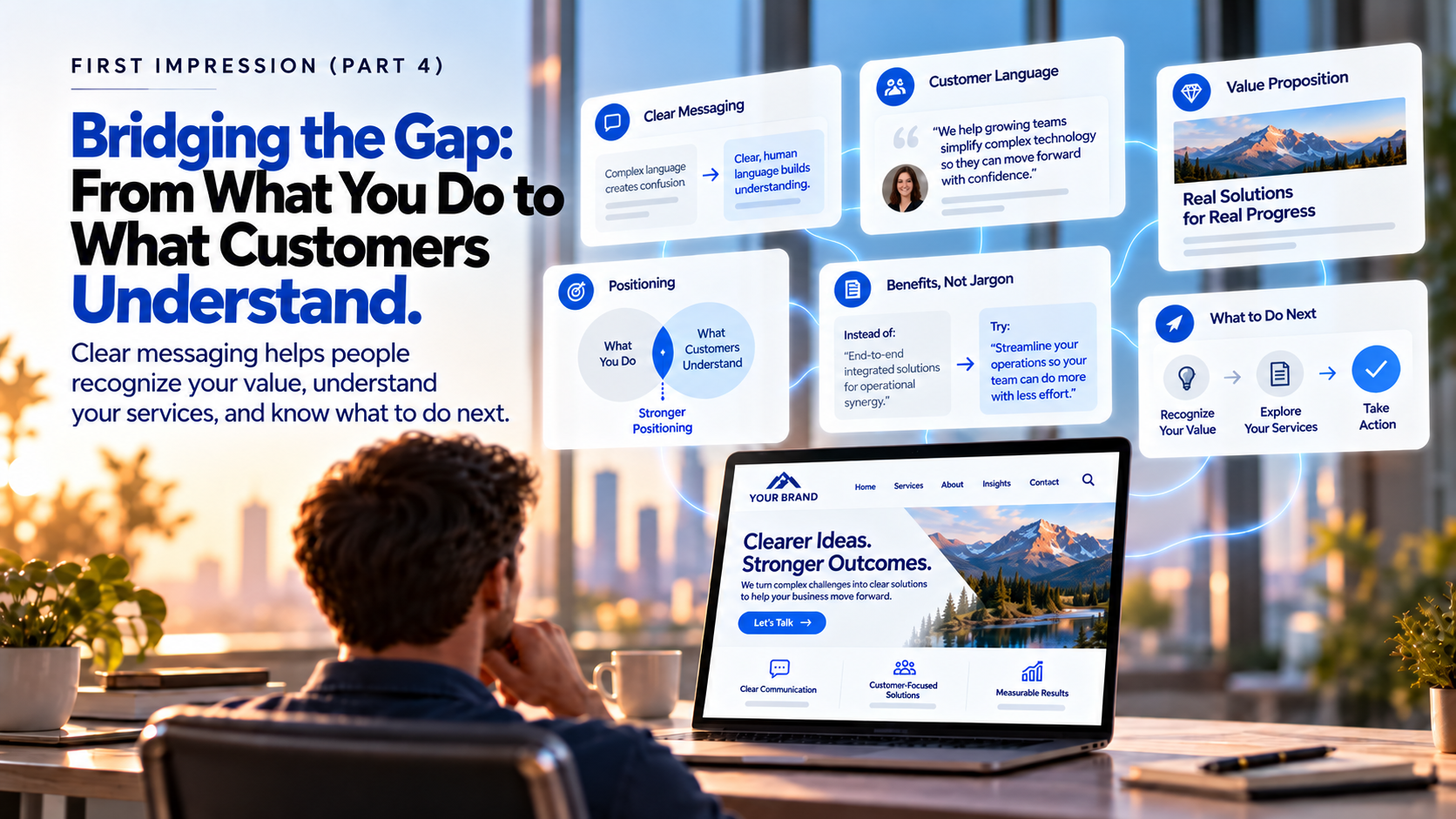
Take the phrase ‘end-to-end operational optimization.’ It may describe a legitimate service. But what will a prospective customer understand from it?
Compare that with an explanation that a company helps manufacturers reduce production delays, improve how work moves between departments, and identify where time and resources are being wasted.
The second version may not be the complete technical description. It is a clearer introduction to the value.
The UK government’s guidance on clear language emphasizes using words people recognize and explaining technical terms when they are necessary. The principle applies well beyond government websites.
You do not need to remove every industry term from your marketing. Some customers expect and appreciate technical language.
You need to know when to use it, when to explain it, and when to begin with something more familiar.
Customers Buy Outcomes, Not Just Capabilities
Think about the way businesses often describe themselves.
We provide comprehensive accounting services. We offer advanced manufacturing capabilities. We deliver strategic consulting solutions.
Each statement tells the reader something about the category of work.
But it does not necessarily explain why that work matters to a customer.
Consider a business advisory firm that offers financial reporting, forecasting, and planning.
Those are capabilities. A potential client might care about making decisions with better information, anticipating cash needs, and avoiding unpleasant surprises as the company grows.
A more useful message connects the two: We help business owners understand where their money is going, plan for what’s ahead, and make decisions with greater confidence.
The firm still needs to explain its services and demonstrate its qualifications. The difference is that it has given the customer a reason to care about those details.
This does not mean promising results you cannot guarantee.
It means connecting what you provide with the problems customers are trying to solve and the improvements they hope to make.
What Makes You Different Must Mean Something to the Customer
Nearly every company wants to be seen as experienced, responsive, innovative, and committed to quality.
Those are worthwhile qualities. But when everyone claims them, they stop helping customers distinguish one company from another.
Imagine comparing three construction firms whose websites all promise exceptional service, experienced teams, and outstanding results.
Which one should you choose?
Now imagine that one firm clearly explains how it manages projects in occupied buildings, coordinates work to minimize business interruption, and keeps clients informed before schedule changes become surprises.
A customer planning a renovation while continuing to operate may find that explanation especially meaningful.
The firm has not relied on bigger adjectives. It has described how its approach addresses a specific concern.
A meaningful difference can come from specialized expertise, a distinctive process, a particular audience, the way customers are supported, or a perspective that shapes how the work gets done.
But it should be a difference you can substantiate.
The strongest positioning is not simply what you want people to believe. It is the intersection between what you do well and what the right customers value.
Clarity Does Not Mean Sounding Like Everybody Else
Some businesses resist simpler language because they worry it will make them sound ordinary.
They want a distinctive brand voice. They do not want to replace their personality with generic explanations.
That concern is reasonable.
But clear communication and memorable communication are not opposites.
A company can be warm, confident, thoughtful, technical, bold, or understated while still making its services understandable.
Think about the difference between a message that says ‘We empower next-generation possibilities’ and one that says ‘We help family-owned manufacturers modernize their operations without losing the personal service their customers value.’
The second message has a point of view. It communicates both who the company serves and what matters to those customers.
Clarity is not about stripping away personality.
It is about making sure personality does not hide the substance.
Good Messaging Begins With Listening
It can be tempting to develop a new message by gathering leadership in a room and asking everyone to describe the company.
That conversation can be useful. It reveals how people inside the organization think about its strengths.
But it is only part of the picture.
Customers may describe the business differently. They may value something the leadership team barely mentions. They may ask questions the website never answers. They may remember the feeling of being guided through a difficult decision more than the impressive list of services they received.
Those observations can be valuable clues.
Look at the questions prospects ask before hiring you. Review what existing customers say when they recommend you. Pay attention to the problems people describe in their own words.
You can also ask recent customers what they were worried about before choosing your organization and what ultimately gave them confidence.
The GOV.UK approach to content design begins with understanding what people need to accomplish, rather than starting with everything an organization wants to say.
Businesses can apply the same principle to websites, proposals, presentations, and sales conversations.
Before deciding what you want to tell people, learn what they need to understand.
The Order of Information Matters
An effective message does not have to explain every detail immediately.
It should create a useful path from initial understanding to deeper evaluation.
On a homepage, that may begin with a clear explanation of who you help and what you help them accomplish.
A service page can then describe the approach, relevant capabilities, and kinds of problems your team addresses.
A case study can make the work more tangible. A conversation can explore the prospect’s specific needs.
Each interaction can answer the next reasonable question.
Problems occur when businesses reverse that sequence. They open with their organizational history, technical process, or lengthy capabilities list and hope the customer eventually discovers why any of it matters.
That makes the reader do the connecting.
The Office for National Statistics’ plain-language guidance recommends clear headings, concise wording, and language organized around the reader’s tasks.
Those are not just editing preferences. They make information easier to find and understand.
Good communication removes unnecessary work from the customer’s decision.
A Consistent Message Makes Every Interaction More Useful
Your website may be the first place someone encounters your business, but it is rarely the only one.
They may also see your LinkedIn profile, download a brochure, review a proposal, or speak with a member of your team.
What happens when each one describes the company differently?
The website emphasizes innovation. The brochure lists products. The sales presentation focuses on personal service. The proposal is full of unexplained technical language.
All of those things might be true. But without a common message, the customer has to assemble the story alone.
A strong messaging foundation helps these different materials support one another.
It does not mean repeating the same sentence everywhere. A proposal should be more specific than a social post. A sales conversation should respond to the person in front of you.
But the basic understanding of whom you serve, what you help them accomplish, and why your approach matters should feel connected.
That is where messaging becomes more than copywriting. It becomes part of how your organization presents itself.
Sometimes the Problem Is Not Your Marketing. It Is the Translation.
Imagine an established engineering firm with deep experience, loyal clients, and an excellent track record.
Its website, however, reads like a catalog of disciplines. Visitors see a long list of services and acronyms, but few explanations of the business problems the firm helps solve.
The company may be exceptionally qualified.
But a prospective customer who is unfamiliar with its terminology may not recognize the connection between those qualifications and their own needs.
The answer may not be an entirely new brand, a larger marketing budget, or more content.
It may be a clearer way of explaining the value already present in the business.
That work takes more than replacing jargon with simpler synonyms.
It requires understanding your audience, identifying the questions that matter, determining what sets your approach apart, and organizing the story around the customer’s point of view.
The goal is not to change what your business is.
It is to close the distance between the value you deliver and the value people recognize.
Bridge the Gap: The Message Check
As you think about how your company communicates, consider these five questions:
Can a first-time visitor explain what your company does and who it helps after reading the opening message on your website?
Does your messaging describe the problems your customers face, or mostly list your services and capabilities?
Are you using words your prospective customers recognize, with technical language explained when necessary?
Can you show what makes your approach different through specific examples rather than broad claims?
Do your website, proposals, social presence, and sales conversations communicate a consistent understanding of your value?
If you hesitate on one or more of these questions, you may not need to reinvent your company story.
You may need to see it from the customer’s side.
A useful first step is to ask someone unfamiliar with your business to describe what you do after spending a minute on your homepage. Listen carefully to what they understand, what they assume, and what they cannot explain.
The gap between their answer and the message you intended can tell you where to begin.
What Comes Next
This is the fourth article in TrueBridge Creative‘s Insights & Impact launch sequence, and the first in our Bridging the Gap series.
The First Impressions articles explore what customers see, experience, and come to believe about a business. Bridging the Gap looks at how organizations can move from the experience they are creating today to one that better reflects the value they provide.
Here, we have focused on the distance between what businesses know about their capabilities and what prospective customers actually understand.
But even when a website communicates clearly, another obstacle can prevent that message from reaching people: the experience of waiting for the page to load.
In our next article, First Impressions: Every Second Matters — How Website Speed Shapes Trust Before Visitors Read a Word, we will explore why technical performance is also part of customer confidence.
Because a message cannot create an impression if the visitor leaves before they see it.
Your business may already be delivering real value.
The opportunity is to help more people understand it.
Is Your Message Making Your Value Clear?
Your marketing should do more than describe your services. It should help the right customers recognize their problems, understand how you can help, and feel confident starting a conversation.
If you are not sure your message is making that connection, TrueBridge Creative can help you find out.