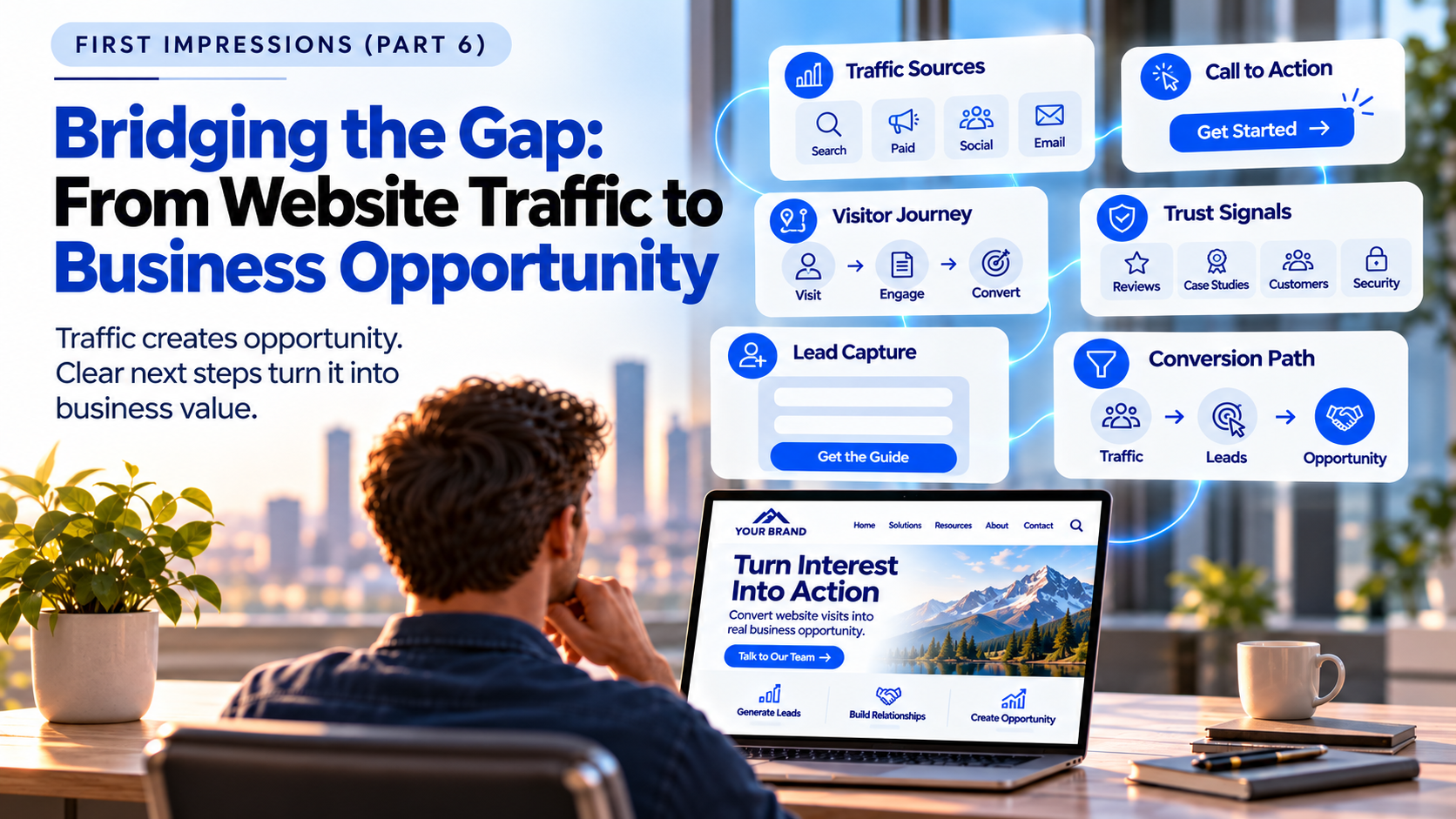
Bridging the Gap – From Website Traffic to Business Opportunity
Imagine a business owner opening the monthly website report and seeing encouraging news. More people visited the site than last month. A recent campaign brought in new traffic, and several pages attracted more attention than expected. The numbers suggest that something is working.
Then the owner asks a different question: How many of those visitors contacted us, requested an estimate, or took a meaningful step toward becoming a customer? The answer is less clear. The phone has not been especially busy. The inquiry form receives only occasional submissions. The sales team cannot connect many new conversations to the website.
The traffic may be real, and the marketing effort may be creating awareness. But visits alone do not tell the company whether that attention is turning into opportunity. People can find a business online without finding a compelling reason to continue. They can read a page without knowing what to do next. And they can be interested in a service without feeling ready to reach out.
This is the gap between attracting visitors and helping them move forward. Closing it is not about pressuring every person who arrives to become a lead. It is about creating an experience that makes the next useful step clear, appropriate, and easy.
Attention Is an Opening, Not an Outcome
In our previous article, First Impressions: Every Second Matters, we explored how website speed and responsiveness influence the experience people have before they even begin reading. A site that loads smoothly allows its message to work. But once the visitor can use the website, another question becomes important: what is the experience helping that person accomplish?
Businesses spend time and money bringing people to their sites through referrals, search, social media, advertising, and helpful content. Those channels matter. They introduce new audiences to a company and can give people a reason to explore. Yet a visitor is not the same thing as a customer, and a page view is not the same thing as a meaningful business conversation.
A successful visit might lead to an inquiry today. It might also help a prospective customer understand the company well enough to return later, share an article with a colleague, or include the business on a shortlist. That makes the goal more thoughtful than simply increasing the number of contact-form submissions. The website should support the kinds of decisions that move the right relationships forward.
Not Every Visitor Is Ready for the Same Next Step
Consider someone researching an architectural firm for a future renovation. They may be months away from choosing a partner. Right now, they want to see relevant projects, understand the kinds of work the firm accepts, and learn what the process might involve. Asking them to schedule a consultation on every screen may be premature. A clear project portfolio or a useful explanation of the planning process may be a more helpful next step.
Now consider a property manager who needs an engineering assessment for an active building issue. That person may already know what service they need and be looking for a qualified firm that can respond. In this case, a visible contact option and a straightforward way to describe the project matter much more than a lengthy educational journey.
Both visitors are potentially valuable. They arrive with different questions and levels of urgency. The strongest websites recognize those differences. They make it easy for people to learn when they need to learn, evaluate when they need reassurance, and act when they are ready.
That begins with understanding visitor intent. Where did someone arrive from? What question brought them to the page? What information would help them make the next reasonable decision? A useful website does not treat every visitor as though they are at the same point in the buying process.
The Right Page Should Answer the Right Question
A homepage often introduces the company to people who know little about it. A service page can explain a specific capability, the kinds of problems it solves, and who it is for. A case study can demonstrate how the organization approaches real work. An article can help a visitor understand a challenge before they are ready to discuss a solution.
When those pages are planned around genuine visitor needs, each one can play a distinct role. Trouble begins when pages exist mainly because the website needs content. A service page lists offerings without explaining why they matter. An article demonstrates expertise but provides no related resources. A case study is interesting yet gives the reader no way to explore similar capabilities.
The result is an experience that may create attention without helping people use that attention. Visitors should not have to invent their own route from useful information to a reasonable next step. Thoughtful internal links, clear navigation, and relevant invitations can create that route without turning every paragraph into a sales pitch.
This is also why our article Bridging the Gap: From What You Do to What Customers Understand remains so important. A button cannot make up for a value proposition the visitor does not understand. Before asking people to act, a website needs to give them a reason that makes sense.
A Call to Action Should Feel Like a Helpful Invitation
Most business owners are familiar with the phrase “call to action.” On a website, it may appear as a button inviting someone to contact the company, schedule a meeting, request a quote, download a resource, or learn more. The concept is simple. The execution deserves more thought.
Imagine reading about a complex professional service you have never purchased before. The page offers only one option: “Get Started.” What will happen if you click? Will you receive a sales call, complete a lengthy form, or begin a purchase? The uncertainty may be enough to make someone hesitate.
Compare that with an invitation such as “Discuss Your Project,” accompanied by a short explanation that the first conversation is meant to understand the scope and answer questions. The second approach tells visitors more clearly what they are choosing. A person who is still exploring might instead appreciate “See Relevant Projects” or “Learn About Our Process.”
Good calls to action are specific, visible, and relevant to the content around them. They should not create a false sense of urgency or promise an outcome the company cannot guarantee. Their job is to reduce uncertainty about what happens next.
Confidence Comes Before the Click
A visitor may be interested in your services and still have reasons to wait. They may wonder whether your organization has worked with businesses like theirs. They may be uncertain about the process, timing, or level of commitment involved in making contact. They may want to know whether a real person will respond.
These questions are not always obstacles that require aggressive persuasion. Often they are reasonable requests for evidence. Relevant examples, clear credentials, concise explanations of how engagements begin, and accurate testimonials can help someone evaluate the company. Easy-to-find contact information can make the organization feel approachable rather than hidden behind the website.
Imagine two firms offering similar business advisory services. One website includes polished claims about trusted solutions and exceptional expertise but little explanation of what it is like to work together. The other identifies the situations it helps clients address, describes its process in familiar language, and shows examples of issues it has helped resolve. Both may be capable. The second has made the decision easier to understand.
This is where branding, messaging, design, and the customer experience support conversion. People are more likely to consider taking a meaningful step when they have enough information to feel comfortable with that step. The click is not the beginning of trust; it is often the result of trust already forming. These disciplines work together within a broader creative and marketing strategy. Learn more about TrueBridge Creative’s services.
Small Frictions Can Interrupt Valuable Intent
Sometimes a website creates a clear reason to inquire, then makes the inquiry unnecessarily difficult. A contact form asks for information a company does not yet need. A “Request a Quote” button leads to a generic page with no explanation of the process. A phone number is visible on a desktop but difficult to reach on mobile. A scheduling link opens an unfamiliar interface without context.
None of these issues necessarily means a business will lose every prospective customer who encounters them. But each asks visitors to spend additional time or effort at a moment when they are deciding whether the relationship is worth pursuing. That is the kind of friction worth examining.
The most effective improvement may be surprisingly modest. Reduce a form to the fields required for a useful first conversation. Add a sentence explaining when someone should expect a response. Place the contact option near relevant service information. Make sure buttons and forms function properly on phones. Confirm that inquiries actually reach the person responsible for answering them.
A website can generate opportunities only if the company is ready to receive and follow up on them. The transition from an online inquiry to a human response is part of the same experience.
More Leads Are Not Always Better Leads
It can be tempting to judge a website by the number of forms it collects. More inquiries seem like an obvious sign of success. Yet a company that receives many requests from people it cannot serve may gain little business value from that volume. Staff spend time sorting through unsuitable projects, and visitors may leave disappointed when they learn the company is not the right fit.
Clear positioning can help with this problem. A specialized manufacturer benefits from describing the types of projects, materials, production requirements, or markets it supports. A consulting firm may need to clarify which organizations it serves and what kinds of challenges warrant its involvement. The point is not to make the business harder to approach. It is to help the right customers recognize a strong fit.
For many professional service organizations, a smaller number of relevant, well-informed conversations can be more useful than a large collection of vague inquiries. That is why traffic, lead quantity, and business opportunity should not be treated as interchangeable measures. A meaningful website strategy considers the quality and eventual usefulness of the interactions it creates.
Measure the Actions That Matter to the Business
Website reports can be full of appealing numbers: visitors, page views, engagement, clicks, and traffic sources. Those measures can help explain how people discover and use the site, but they do not automatically reveal which interactions matter most to the business.
A more useful approach starts by identifying the actions that represent progress. For a professional services firm, those might include qualified inquiry submissions, calls initiated from important pages, consultation requests, or downloads that support a meaningful follow-up. For another organization, they might involve product inquiries, applications, registrations, or requests for technical information.
Google Analytics distinguishes important website actions as “key events,” while using “conversions” more specifically to measure and optimize advertising outcomes. The terminology may change across tools, but the underlying discipline is the same: decide which actions matter before choosing the numbers you will use to assess success. Measurement should reflect the business, not merely the software dashboard.
It is also important to look beyond clicks. A submitted form may not be a qualified opportunity. A phone call may lead to a valuable project, a routine service question, or nothing at all. Connecting website interactions to the conversations that follow—while respecting privacy and collecting only appropriate information—helps businesses make better decisions than isolated page statistics can.
No analytics platform can reveal every influence on a purchasing decision, particularly when customers research over time and return through different channels. Reports are evidence to interpret, not a complete explanation of human behavior. Combining that evidence with sales feedback and customer questions often creates a more useful picture.
Improve the Journey Before Buying More Attention
When results disappoint, the instinct is sometimes to increase the advertising budget or publish more content. Those investments may be worthwhile, but they can also send more visitors into an experience that is not yet helping people move forward. Before spending more to attract attention, it is reasonable to examine what happens to the attention already arriving.
Start with the pages that matter to your organization. Ask someone unfamiliar with the company to arrive on a service page from a search result. Can they tell whom the service is for? Can they find the evidence they need? Is there a next step that matches their interest? If they try to contact the company, can they complete the process without guessing or repeating themselves? This is also part of the principle discussed in First Impressions (Part 3): A Beautiful Website Isn’t Enough.
Then review what happens internally. Who receives the inquiry? How quickly is it acknowledged? Does the sales team understand which service or content prompted the conversation? Can the organization recognize patterns in the questions that prospects ask? A website cannot carry the entire customer relationship, but it should connect smoothly with the people responsible for continuing it.
The right next improvement may involve a clearer service description, a stronger project example, a better contact form, or a more useful invitation to explore related information. It may not require a redesign. The value comes from removing the specific obstacles that stand between a visitor’s interest and the business opportunity that interest could become.
The Goal Is Progress, Not Pressure
An effective website does not need to turn every visitor into an immediate sales lead. People arrive for different reasons, and good experiences respect that. Someone who leaves with a clearer understanding of the company may be better prepared to return. Someone who shares a helpful article may introduce the business to a future customer. Someone who requests a conversation may be ready to take a more direct step.
The opportunity is to make those paths understandable and connected. When visitors can recognize their needs in the message, find credible information, and choose an appropriate next step, the website becomes more than an online destination. It begins supporting the relationships and decisions that help the business grow.
Traffic shows that people are arriving. What matters next is whether the experience gives the right people a reason—and a practical way—to continue.
Bridge the Gap: Is Your Website Turning Interest Into Opportunity?
As you consider what happens after visitors reach your website, ask these five questions:
- Do your most important pages make it clear who you serve, what problems you help solve, and why a visitor should continue?
- Does each page offer a useful next step that matches what a visitor is likely trying to accomplish?
- Can prospective customers find credible examples, understand the process, and contact you without unnecessary effort?
- Are you evaluating the relevance and quality of inquiries—not just traffic totals and form submissions?
- Do your website, analytics, and internal follow-up process help you understand which interactions become meaningful conversations?
If some answers are unclear, the best response may not be a bigger campaign. Begin by tracing a realistic visitor journey from arrival to the next step, then ask where the experience makes someone work harder than necessary. That exercise can reveal improvements that are both smaller and more valuable than a sweeping redesign.
What Comes Next
This is Part 6 of TrueBridge Creative’s First Impressions series and the sixth article in our Insights & Impact launch sequence. So far, we have looked at the impressions a business creates, the brand those impressions form, the role of effective website design, the importance of clear messaging, and the way website performance can build or weaken confidence.
Here, we have explored what happens once people arrive: whether the website helps them find relevant answers, recognize value, and take an appropriate next step. But every journey begins somewhere, and the first encounter is not always on a page the company controls.
In our next article, First Impressions: What Does Google Say About Your Business Before You Get the Chance?, we will look at how search results, reviews, business listings, and other public information can shape a prospective customer’s opinion before they visit your website or speak with your team.
Because turning interest into opportunity matters. So does understanding the impression that creates that interest in the first place.
Is Your Website Creating Business Opportunity – or Just Traffic?
Your website should do more than attract visitors. It should help the right people understand what you offer, feel confident about your capabilities, and find a sensible way to move forward. If you are unsure where that journey is working and where it is falling short, TrueBridge Creative can help you identify the opportunities for improvement.